
What the Runway Actually Means for Real Wardrobes

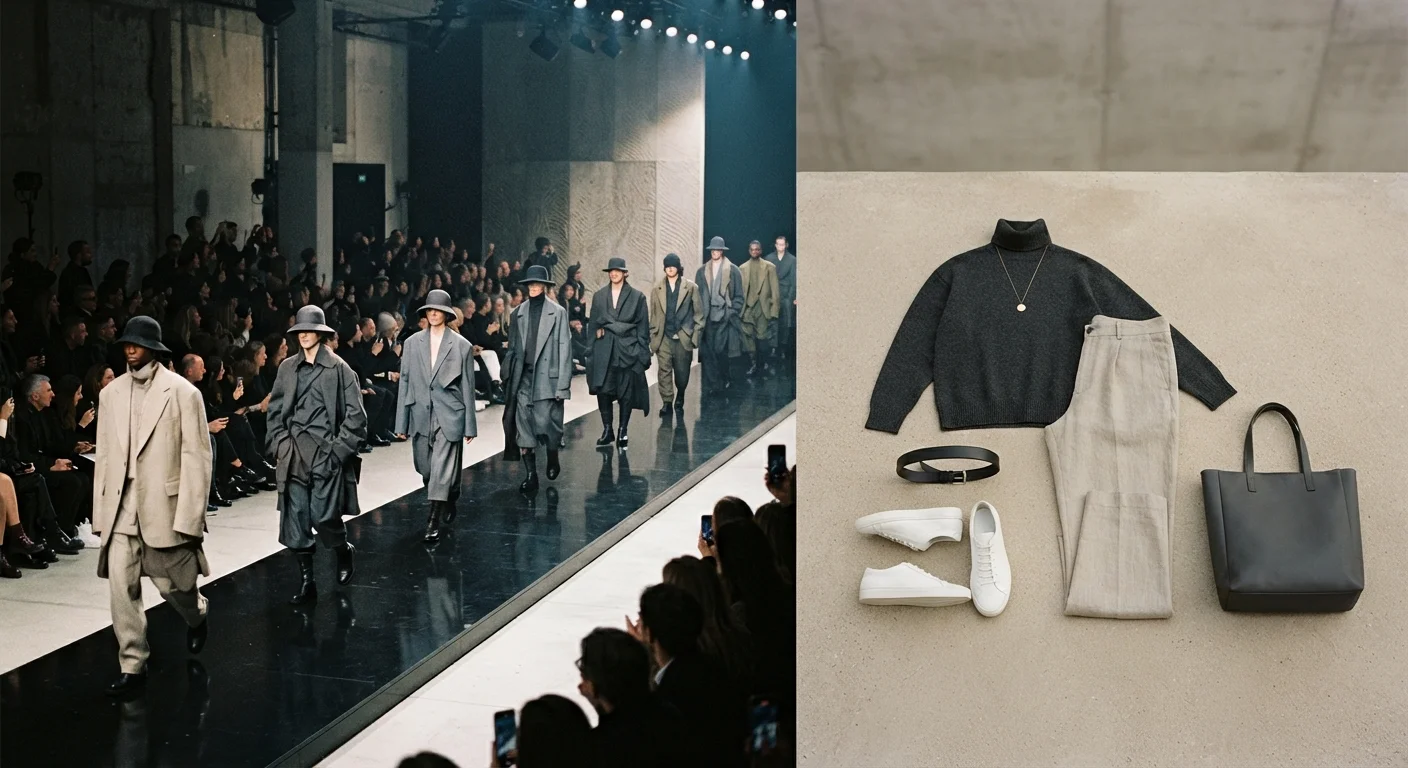
Photo: UnlockTopics.com | Unlocking Trending Content editorial
Key Takeaways
- Runway collections are creative statements, not shopping guides — they signal direction, not prescription.
- Trends move from runway to consumer market through a chain of adaptation that strips out the most extreme elements.
- Identifying a trend's core idea (a silhouette, a color, a proportion) helps you apply it practically without buying anything new.
- Social media has compressed this filtering process, meaning trend signals now reach everyday dressing faster than ever.
- The most useful runway information is directional — it tells you what's coming, not what you must wear.
The Purpose of a Runway Show (It's Not What You Think)
Fashion week runways are not catalogs. The clothes that walk down them are often unwearable by conventional standards — structured beyond comfort, priced beyond reach, or styled in ways that require a team of professionals to execute. That's intentional. A runway show is a brand's most public creative statement, designed to generate press, set the cultural tone for a season, and position a label within the industry.
For working designers, these shows influence buyers, editors, and other designers far more directly than they influence everyday shoppers. A silhouette or color palette debuted on a Paris or New York runway will typically travel through layers of commercial interpretation before it shows up on a rack anywhere most people shop. Understanding that gap is the first step to using runway information usefully. For a primer on the vocabulary that surrounds these collections, a plain-language glossary of fashion terminology can help decode what you're reading.
How Trends Actually Travel from Runway to Wardrobe
The path a trend takes is less a straight line and more a chain of translation. After runway shows, trade buyers select commercially viable pieces for department and specialty stores. Fashion editors and stylists then interpret those selections for editorial features, which shapes what readers and followers actually see styled in context. Retailers at different price points adapt the prevailing direction into their own product lines, often distilling a complex runway concept into a single wearable element — a sleeve shape, a hem length, a print motif.
By the time a trend is visible at the street level, it has been filtered multiple times. What remains is usually the most accessible and broadly appealing version of the original idea. This is why social media's compression of the trend cycle matters: fewer filtering stages now occur before a look reaches wide audiences, which can make trends feel more extreme or less refined than in previous decades.
12–18 months
Traditional runway-to-retail trend lag
Fashion industry analysts have long cited this window as the standard cycle from designer runway to mainstream retail availability, though social media has shortened it considerably in many categories.
4–6 weeks
Fast fashion's average trend-to-shelf turnaround
Industry reporting on fast fashion production models consistently notes turnaround times of four to six weeks from trend identification to in-store availability.
~20%
Runway pieces that reach commercial production
Fashion business analysts estimate that only a fraction of pieces shown on a runway are ever produced commercially, with the rest serving purely editorial or brand-positioning purposes.
Extracting What's Actually Useful
Rather than trying to replicate runway looks, the more practical skill is identifying what a season's collections signal in aggregate. When multiple designers show oversized tailoring, that's a direction worth noting — not because you should buy a new blazer, but because relaxed proportions in suiting are gaining cultural traction. When earthy neutrals dominate several major collections simultaneously, that's a color story likely to be widely available and well-matched to existing wardrobe basics.
The questions worth asking are: Does this direction align with my lifestyle? Does it complement what I already own? Does it solve a gap in my wardrobe? Those three filters turn trend awareness into genuine style utility. This approach pairs naturally with a seasonal capsule framework, where you're rotating thoughtfully rather than reacting to each new cycle.
Use Runway Coverage as a Color and Proportion Forecast
When Runway Trends Are Worth Ignoring
Some runway directions never meaningfully translate to everyday life — and don't need to. Hyper-conceptual silhouettes, avant-garde fabrication, and looks built around elaborate styling are part of fashion's cultural conversation, but they're not instructions. The risk of taking runway content too literally is either chasing trends that don't suit your actual life or experiencing the kind of trend fatigue that comes from treating fashion as an obligation rather than a resource.
A more durable strategy anchors style in foundational wardrobe pieces that remain useful across seasons, then uses trend signals selectively to refresh or refine — not reinvent. Runway collections, at their best, are a lens on what's culturally interesting right now. Used that way, they're genuinely valuable. Used as a mandate, they mostly create noise.
Frequently Asked Questions
The content on this site is for informational purposes only and is not a substitute for professional advice. Always consult a qualified professional for guidance specific to your situation.