
Home Electronics You Should Plug Into a Surge Protector (and Why)

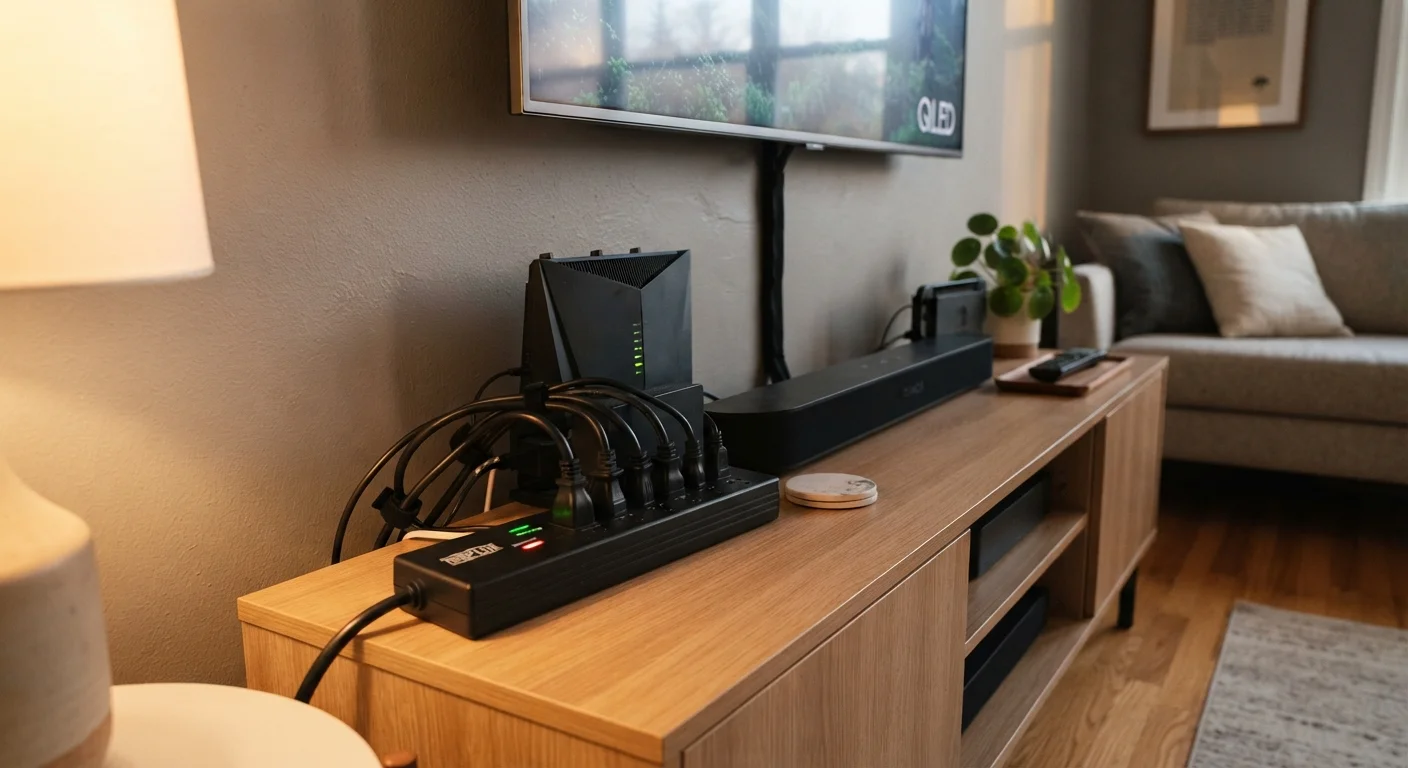
Photo: UnlockTopics.com | Unlocking Trending Content editorial
Key Takeaways
- Power surges can permanently damage expensive electronics even if they appear to work fine afterward.
- Devices with internal processors or sensitive circuits benefit most from surge protection.
- Not all power strips include surge protection — look for a joule rating on the label.
- Smart home hubs, routers, and TVs are among the highest-priority devices to protect.
- A surge protector does not replace a UPS (uninterruptible power supply) for devices needing battery backup.
What a Surge Protector Actually Does
Most households experience power surges more often than they realize. A surge is a brief spike in electrical voltage — sometimes caused by lightning, sometimes by the utility grid switching loads, and sometimes by large appliances like refrigerators cycling on and off inside your own home. These spikes can last microseconds, but the damage they do to sensitive circuits can be permanent.
A surge protector works by diverting excess voltage away from your plugged-in devices and absorbing it through internal components (most commonly a metal oxide varistor, or MOV). When voltage spikes beyond a safe threshold, the protector absorbs it before it reaches your electronics. One important detail: surge protectors wear out over time. Each absorbed surge degrades capacity, which is why devices with a joule rating and an indicator light showing protection status are worth seeking out.
It's also worth clarifying what a surge protector isn't. A standard power strip — the kind with multiple outlets and nothing else — offers no protection at all. It simply extends your wall outlet. Always check for a listed joule rating before assuming a power strip is protecting anything.
Surge Protectors vs. UPS Devices
The devices listed below represent categories of electronics that are broadly recognized as vulnerable to surge damage. Specific protection needs vary by household setup and local electrical conditions.
Devices That Should Always Be on a Surge Protector
Televisions and Streaming Devices
Modern televisions are essentially large computers. They run operating systems, connect to the internet, and process video signals through layers of sensitive circuitry. A voltage spike — even a small one — can degrade picture quality, corrupt firmware, or destroy the display panel entirely. Streaming sticks and boxes connected to those TVs face the same risk and are often overlooked.
Plug your TV and any attached streaming hardware into the same surge-protected strip to keep the entire entertainment chain covered.
A modern TV is essentially a large computer — its circuits are just as vulnerable to voltage spikes.
Router and Modem
Your router and modem are the gateway to every connected device in your home. Surge damage to networking equipment doesn't always manifest immediately — it can cause intermittent disconnections, degraded speeds, or random reboots that are difficult to diagnose. Because these devices run continuously, they're exposed to surge risk around the clock.
Protecting your router is especially critical if your household relies on smart home automation, remote work, or any device that depends on a stable internet connection.
Networking gear runs 24/7, making it continuously exposed to surge risk day and night.
Desktop Computers and Monitors
Desktop computers contain hard drives or SSDs storing irreplaceable data, along with motherboards, graphics cards, and RAM that are expensive to replace. A surge can corrupt stored data even if the hardware survives visually intact. Monitors, which contain their own power supply and display electronics, are equally vulnerable.
For setups with multiple accessories connected through hubs or docks, a single protected power strip can cover the entire desk ecosystem in one step.
A surge can corrupt stored data on a desktop even when the hardware looks physically unharmed.
Smart Home Hubs and Voice Assistants
Smart home hubs coordinate communication between dozens of devices — lights, thermostats, locks, and sensors. If a surge damages or resets a hub, it can knock the entire household automation system offline and require lengthy reconfiguration. Voice assistants face the same problem, as they store device pairings, routines, and preferences that may not fully restore after a hard power failure.
Because these devices are always listening and always on, they have no natural downtime during which to absorb a surge safely.
Losing a smart hub to a surge can force complete reconfiguration of every connected device in your home.
Gaming Consoles
Gaming consoles combine hard drives, custom processors, and optical drives in a single unit that can cost several hundred dollars to replace. Many modern consoles also download and cache large amounts of data, meaning a surge-caused drive failure can wipe locally stored games, save files, and settings. Because consoles are often left in standby mode — not fully powered off — they remain connected to the power supply and exposed to surges even when not in active use.
Consoles left in standby mode stay connected to power and remain vulnerable to surges around the clock.
Laptop and Tablet Chargers
The charger for a laptop or tablet contains a power adapter that converts wall voltage to a level safe for the device's battery. A surge traveling through the outlet can overwhelm that adapter and pass harmful voltage directly into the battery or charging circuit. While some devices include internal protection, it's not designed to handle significant surge events, and battery damage is often expensive to repair.
Plugging chargers into a surge-protected outlet adds a layer of defense that the device's own circuitry is not built to provide alone.
A laptop charger's built-in protection is not designed to handle significant power surge events on its own.
Check the Joule Rating Before You Buy
Building a Smarter, More Protected Home Setup
Surge protection is most effective when treated as a deliberate part of how you set up each area of your home — not an afterthought. Group devices by location and function: your entertainment center, your home office desk, and your networking closet or shelf each deserve their own protector rated appropriately for the combined load.
If your household runs on smart home devices, a single surge event can disrupt every connected system at once, from lighting schedules to door locks. That makes the router and smart hub among the most strategically important devices to protect. Learn more about how your home network underpins every smart device you own — protecting that foundation is protecting everything downstream.
For desktop computers with multiple peripherals and hubs, understanding how accessories connect through ports, hubs, and docks can also help you consolidate outlets and reduce the number of unprotected connections. And before installing a smart home ecosystem, it's worth building in surge protection from the start rather than retrofitting it later.
Surge protectors are a modest, one-time investment compared to the cost of replacing a television, router, or computer. The key is choosing protectors with a sufficient joule rating for the devices connected, confirming the protection-active indicator is lit, and replacing units after significant electrical events or every few years as a precaution.
The content on this site is for informational purposes only and is not a substitute for professional advice. Always consult a qualified professional for guidance specific to your situation.