
Why Minimum Payments Keep You in Debt Longer Than You Expect

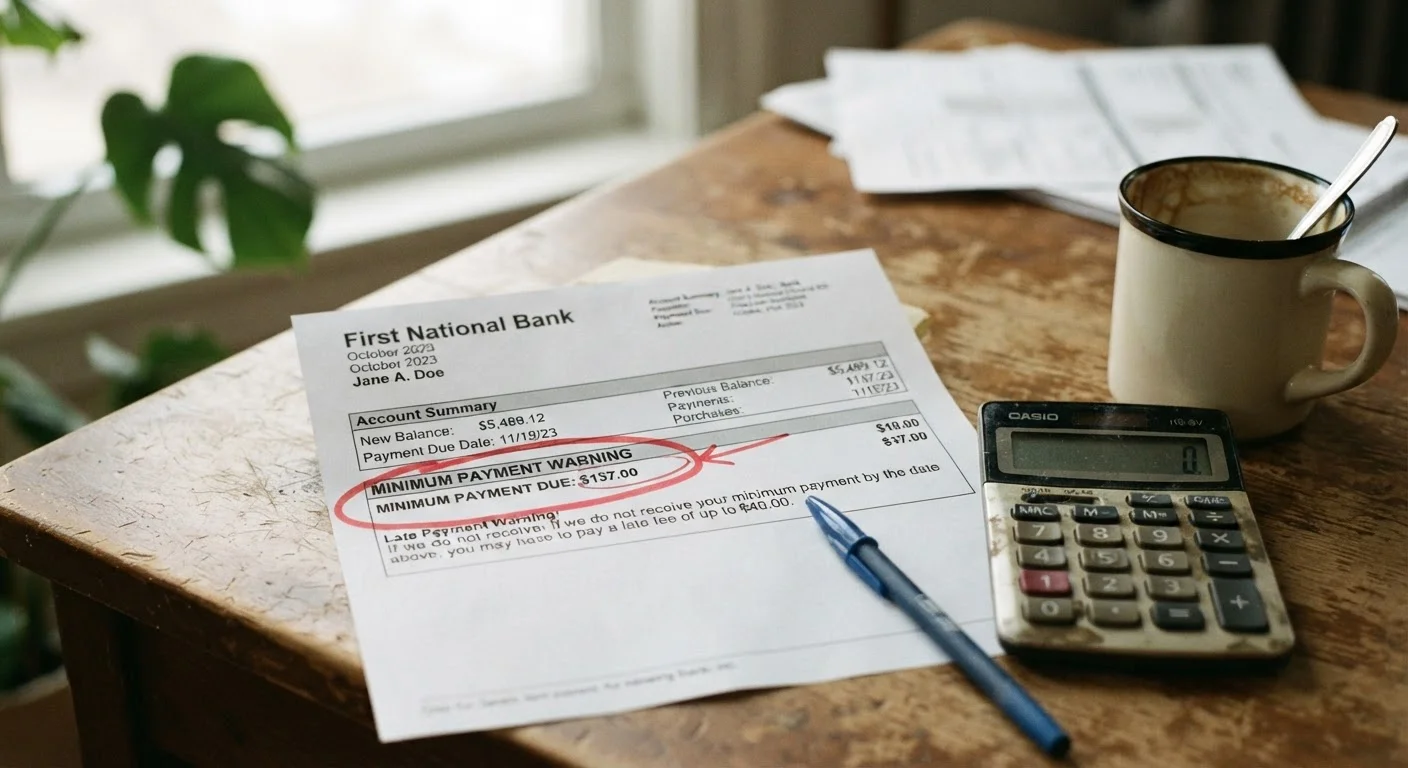
Photo: UnlockTopics.com | Unlocking Trending Content editorial
Key Takeaways
- Minimum payments are designed to keep balances - and interest charges - alive as long as possible.
- Most of a minimum payment goes toward interest, leaving very little to reduce your actual balance.
- Even a modest increase above the minimum can cut years and hundreds of dollars off your repayment.
- Understanding how compound interest works is the first step to escaping the minimum-payment trap.
The Math Behind Minimum Payments
When a credit card statement arrives, the minimum payment figure looks reassuringly small - often just 1-2% of the balance, or a flat floor amount, whichever is higher. But that number isn't there to help you pay off debt quickly. It's the lowest amount your issuer will accept, and staying at that level means interest continues to accumulate on the bulk of what you owe.
Here's the core mechanics: credit card interest is calculated on your average daily balance, then compounded monthly. If your APR is 22% and you carry a $3,000 balance, roughly $55 in interest accrues in a single month. A minimum payment around $60 wipes out almost none of the principal - the actual money borrowed. The next month's interest calculates on a balance that's barely moved.
27+ years
Estimated payoff time on $4,000 at 20% APR (minimum payments only)
Based on a 2% minimum payment formula - a common industry standard - compounding ensures the balance shrinks very slowly without additional payments.
~$0.02
Principal reduction per dollar of minimum payment at high APRs
When APRs exceed 20%, the majority of each minimum payment covers accrued interest, with only a small fraction reducing the underlying balance.
This cycle is sometimes called the minimum-payment trap, and it's mathematically relentless. The Consumer Financial Protection Bureau (CFPB) has noted that card issuers are required to disclose how long payoff takes if you only make minimum payments - check that box on your statement. The number is frequently startling.
Common Mistakes That Keep Balances Growing
Understanding the math is one thing; recognising the habits that lock you into it is another. Below are the most frequent errors people make - and what to do instead.
Treating the minimum payment as the 'normal' payment amount.
Continuing to use a card while trying to pay it down.
Ignoring the payoff timeline disclosed on your statement.
Assuming a lower APR offer cancels out the need to pay more.
Making only one lump-sum payment per billing cycle instead of splitting payments.
If you're unsure where minimum payments fit into a broader repayment plan, the Debt Snowball vs. Debt Avalanche comparison walks through two structured approaches for tackling balances more aggressively.
What It Actually Costs to Pay the Minimum
Numbers make this concrete. Consider a $4,000 credit card balance at a 20% APR. Paying only the minimum - calculated as 2% of the balance - would take roughly 27 years to pay off and cost more than $6,000 in interest alone, more than the original balance itself. Doubling the initial minimum payment to a fixed amount and holding it there cuts that timeline to under four years and saves thousands in interest charges.
New Purchases Undo Your Progress
These figures are illustrative estimates based on standard minimum-payment formulas - your actual outcome will depend on your specific APR, how your issuer calculates minimums, and whether you add new charges. Most card issuers offer online calculators to model your own scenario.
For a working vocabulary around the terms involved - APR, compounding, principal - the Plain-English Glossary of Debt and Credit Terms is a useful companion reference.
Practical Steps to Break the Cycle
You don't need a windfall to make meaningful progress. A few deliberate changes can shift the trajectory significantly.
- Fix your payment above the minimum. Commit to a set dollar amount - even $25 or $50 more per month - rather than letting it shrink as your balance falls.
- Target high-interest balances first. Directing extra payments to the card with the highest APR reduces the rate at which interest compounds across your total debt.
- Stop adding to the balance. New charges reset the math. If you're in repayment mode, use a debit card or cash for everyday spending where possible.
- Look into consolidation carefully. A personal loan or balance transfer at a lower rate can reduce compounding costs - but only if you understand the terms and avoid accumulating new debt. The Debt Consolidation guide covers when this makes sense and when it doesn't.
When Minimum Payments Aren't Enough to Cover Interest
If debt is beginning to feel unmanageable rather than just uncomfortable, the Warning Signs That Debt Is Becoming Unmanageable article can help you assess the situation more clearly. And for the full context on how credit and debt interact in your financial life, see the complete guide to debt and credit.
This article is for general informational and educational purposes only and does not constitute personalised financial or legal advice. For guidance specific to your situation, consider consulting a qualified financial professional.
The content on this site is for informational purposes only and is not a substitute for professional advice. Always consult a qualified professional for guidance specific to your situation.