
Insulation Materials Explained: Mineral Wool, PIR Board, and Spray Foam Compared

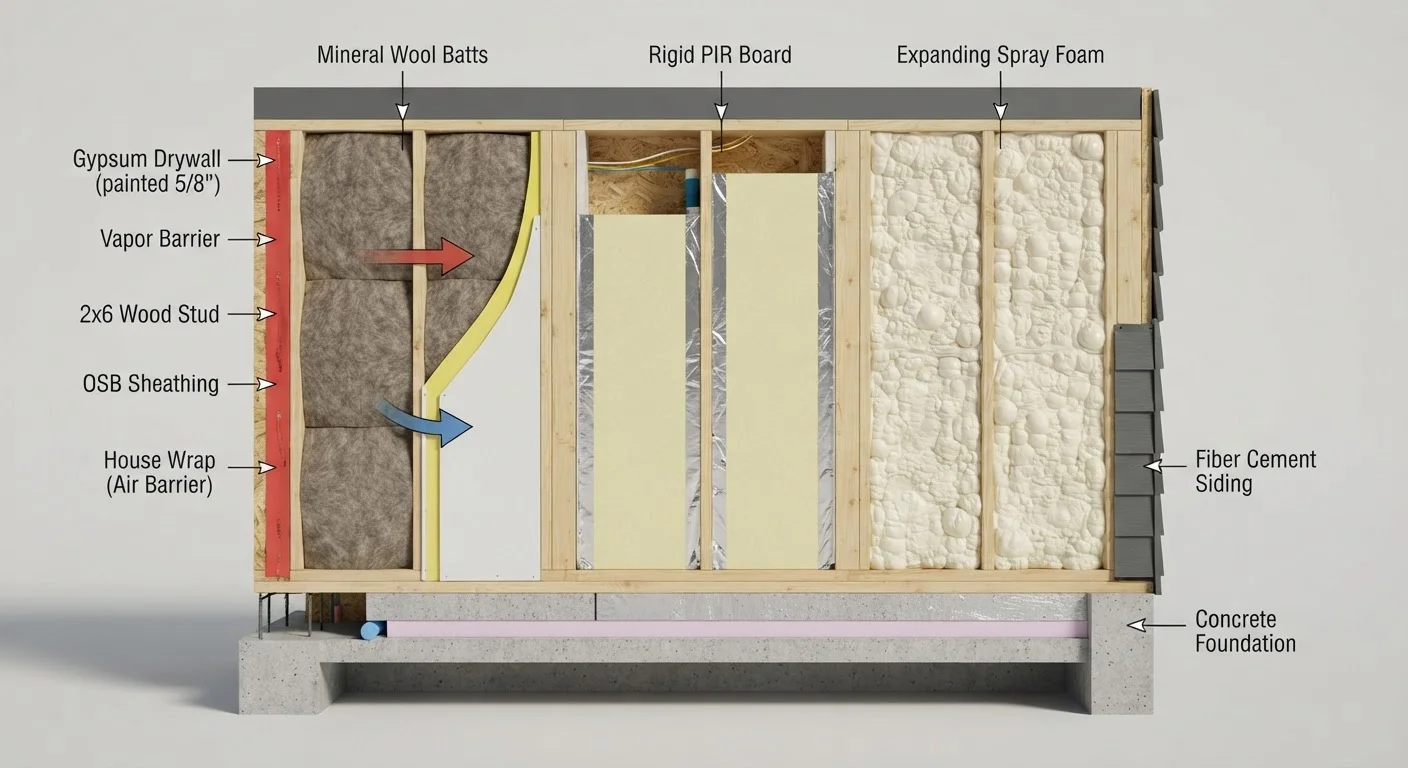
Photo: UnlockTopics.com | Unlocking Trending Content editorial
Key Takeaways
- Mineral wool suits most standard stud and masonry walls and handles moisture and fire well.
- PIR board delivers the highest thermal resistance per inch, making it ideal where space is tight.
- Spray foam seals gaps completely but can complicate future repairs, resale, and mortgage applications.
- No single material is universally best - the right choice depends on your wall type, budget, and long-term plans.
- Some insulation work requires permits or licensed contractors; always check local codes before starting.
Why the Material Choice Matters More Than the R-Value Label
Insulation is often reduced to a single number - the R-value, which measures thermal resistance per inch of thickness. A higher R-value means less heat passes through, but stopping there misses the full picture. The same R-value can behave very differently depending on whether the material stays dry, breathes, or bridges air gaps - and those factors are what determine real-world performance over decades.
Mineral wool (also called rock wool or stone wool), polyisocyanurate rigid board (PIR), and spray polyurethane foam are the three materials most commonly encountered in residential wall, roof, and floor insulation projects. Each has a different manufacturing process, installation method, and set of trade-offs. Understanding those differences helps you ask the right questions when planning a retrofit or new build - and helps you evaluate what a contractor recommends. Before starting any project, check with your local building department, as permits and licensed installation may be required depending on the scope and location of the work.
If you want to identify where your home is actually losing heat first, the room-by-room draught and heat-loss audit is a useful starting point before committing to any material.
Mineral Wool: Reliable, Breathable, and Fire-Resistant
Mineral wool is spun from molten rock or recycled slag and compressed into batts, rolls, or rigid slabs. Its R-value typically falls between 3.0 and 3.3 per inch - comparable to fiberglass but with a notably denser structure that gives it additional benefits beyond thermal resistance alone.
Because mineral wool does not absorb water readily and allows vapor to pass through it, it works well in assemblies that need to manage moisture - masonry walls, timber frame construction, and areas where condensation risk is a concern. It is also non-combustible, which matters in fire-rated assemblies and is a reason it is commonly specified in commercial buildings.
On the acoustic side, mineral wool's density makes it one of the more effective incidental sound absorbers among common insulation materials. If noise reduction matters in your project, it is worth noting - see the guide to acoustic comfort at home for how insulation fits into a broader noise-reduction strategy.
Match the Material to the Assembly
Installation is straightforward enough for experienced DIYers in accessible stud bays, though any work touching electrical wiring, vapor barriers, or exterior sheathing should be reviewed against local building codes.
PIR Board: High Performance in a Thin Profile
Polyisocyanurate rigid board is a foam-core panel faced with reflective foil on both sides. Its R-value ranges from approximately 5.6 to 6.5 per inch - significantly higher than mineral wool - which makes it the go-to choice when wall depth is constrained and you need to maximize thermal resistance without sacrificing interior floor space.
PIR board is commonly used in flat roofs, over-rafter installations, and internal wall lining applications. It cuts cleanly with a saw or sharp knife and can be adhered directly to masonry. The foil facing also acts as a vapor check, which simplifies some assemblies - but means the board must be correctly positioned within the wall build-up to avoid trapping moisture in the wrong place.
| Mineral Wool | PIR Board | Spray Foam | |
|---|---|---|---|
| Typical R-value per inch | 3.0-3.3 | 5.6-6.5 | 3.7-7.0 (type dependent) |
| Moisture handling | Vapor-permeable, does not absorb water | Vapor check (foil-faced) | Closed-cell acts as vapor barrier |
| Fire resistance | Non-combustible | Requires fire-rated facing | Combustible; needs thermal barrier |
| Acoustic performance | Good sound absorption | Moderate | Low to moderate |
| DIY suitability | Accessible areas, yes | Manageable with care | Generally not recommended |
| Reversibility | Easy to remove or replace | Removable with effort | Difficult; may damage structure |
| Best application | Stud walls, lofts, masonry | Slim wall profiles, flat roofs | Crawl spaces, complex voids |
One limitation: PIR's stated R-value can degrade slightly over time as the blowing agents in the foam gradually diffuse, a process called thermal drift. This is a documented property of the material, not a defect, but it is worth factoring into long-term performance expectations. When comparing certified products, the guide to home product certifications and standards explains which labels to look for and what they actually verify.
Spray Foam: Total Air Sealing With Significant Caveats
Spray polyurethane foam is applied as a liquid that expands and hardens on contact with surfaces, sealing every gap, crack, and irregular void it reaches. It comes in two main types: open-cell foam (lower density, lower R-value, vapor-permeable) and closed-cell foam (denser, R-value of roughly 6.0-7.0 per inch, vapor barrier). The air-sealing performance of either type is its main practical advantage over batts or boards.
Where spray foam causes concern is in reversibility. Once cured in a timber roof structure, for example, removing it means removing or damaging the timber it has bonded to. This has real implications: some mortgage lenders in the US have historically declined or flagged properties with spray foam in certain locations, particularly when sprayed directly onto roof rafters, because of the difficulty of future inspection and repair. This is a factor worth discussing with a real estate professional or lender before proceeding if you plan to sell the property.
Spray Foam Can Affect Mortgage Eligibility
Spray foam also off-gasses during installation, requiring the space to be vacated and properly ventilated. Licensed professional installation is generally expected for closed-cell applications, and building permits are commonly required. It is not a suitable DIY project in most circumstances.
For comparison with other ways of managing how your home stores and releases heat, the article on thermal mass and its role in home temperature provides useful context on how insulation and mass interact in a building assembly.
The content on this site is for informational purposes only and is not a substitute for professional advice. Always consult a qualified professional for guidance specific to your situation.