
Reusable vs. Disposable Household Supplies: How to Think Through the Trade-Offs

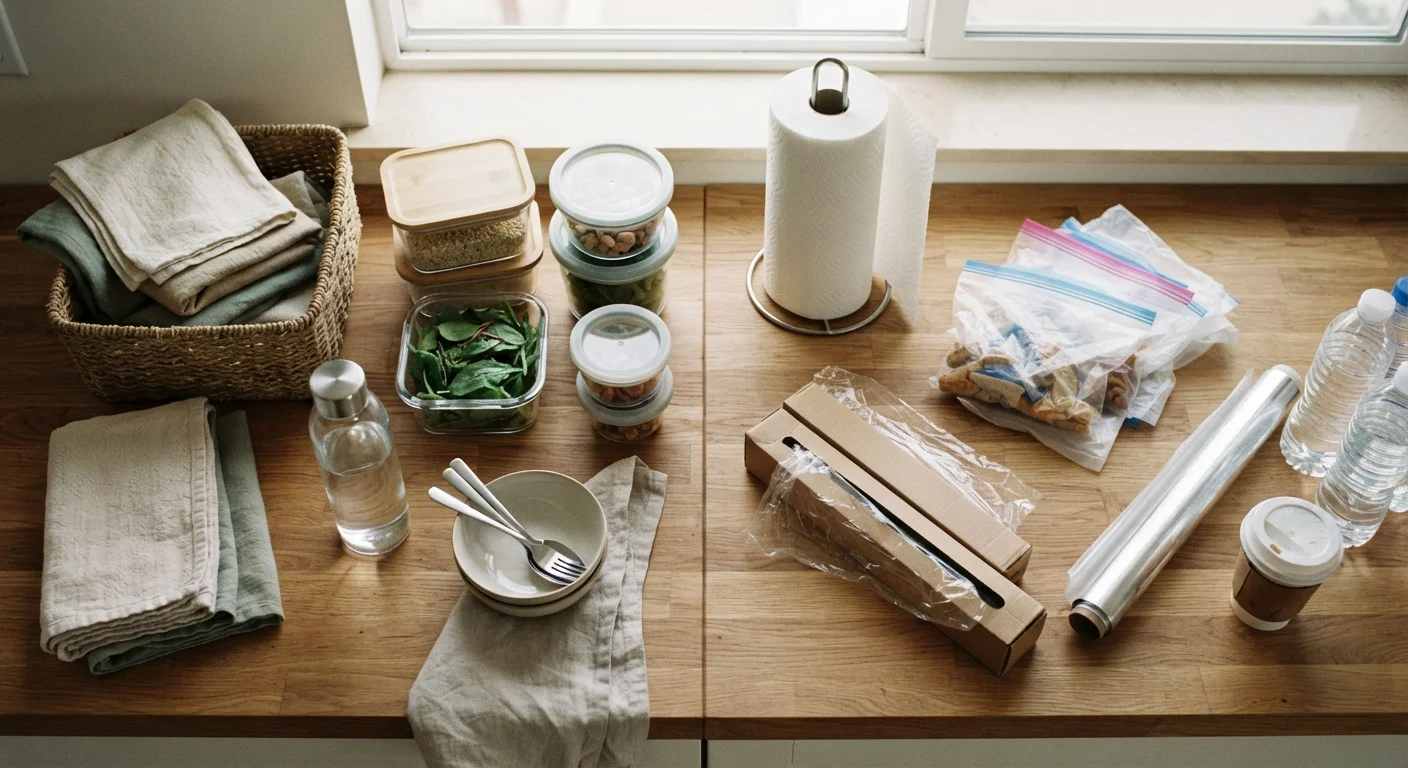
Photo: UnlockTopics.com | Unlocking Trending Content editorial
Key Takeaways
- Reusable supplies typically cost more upfront but can reduce ongoing spending over time.
- Disposable products offer genuine convenience advantages in high-turnover or sanitation-sensitive situations.
- The right choice often depends on household size, usage frequency, and storage capacity.
- Neither category is universally better - a mixed approach suits most households.
Lower cost per use over time
When used consistently, reusables spread their upfront cost across dozens or hundreds of uses, making them more economical than repeatedly buying disposables for the same task.
Reduced ongoing purchasing and waste
Reusables eliminate the recurring need to restock consumables, which simplifies shopping and reduces the volume of packaging and material discarded over time.
Often higher functional quality
Many reusable products - cloth towels, glass containers, durable tools - are made to a higher standard than their disposable equivalents, delivering better performance per use.
Fewer emergency restocking situations
Running out of a reusable item is uncommon once you own it; disposables require consistent monitoring and repurchasing to avoid running short at inconvenient times.
Higher upfront purchase cost
A quality set of reusable supplies - beeswax wraps, silicone bags, cloth napkins - requires more initial spending than disposable equivalents, which can be a real barrier for budget-constrained households.
Requires maintenance, storage, and discipline
Reusables only deliver value if they're washed, stored properly, and actually used again - habits that add a small but real ongoing workload, especially in busy households.
Durability varies widely by product quality
Not all reusable alternatives last as long as advertised; lower-quality versions may degrade quickly, narrowing or eliminating the cost and environmental advantage.
Less suitable for sanitation-sensitive tasks
In contexts where cross-contamination is a concern - illness, food allergen management, wound care - disposables offer a cleanliness assurance that reusables cannot reliably match.
The Core Trade-Off: Upfront Cost vs. Ongoing Spend
The financial case for reusables rests on frequency of use. A set of washable food storage containers, for example, costs more at the register than a box of zip-lock bags - but that gap narrows every time you avoid a disposable purchase. The break-even point varies by product and household, but the principle holds: if you use something regularly, a durable version almost always becomes cheaper per use over time.
Disposables reverse that logic. When a task is rare - cleaning up after a one-time project, handling something you'd rather not launder - the lower upfront cost and zero maintenance makes the disposable the practical call. Paying less for something you'll use once or twice is straightforward value.
This is why the question isn't really reusable vs. disposable in the abstract. It's: how often will I use this, and what does the full cost of ownership look like either way? For a deeper look at how replacement patterns affect long-term spending, see The Replacement Trap.
Lower cost per use over time
When used consistently, reusables spread their upfront cost across dozens or hundreds of uses, making them more economical than repeatedly buying disposables for the same task.
Reduced ongoing purchasing and waste
Reusables eliminate the recurring need to restock consumables, which simplifies shopping and reduces the volume of packaging and material discarded over time.
Often higher functional quality
Many reusable products - cloth towels, glass containers, durable tools - are made to a higher standard than their disposable equivalents, delivering better performance per use.
Fewer emergency restocking situations
Running out of a reusable item is uncommon once you own it; disposables require consistent monitoring and repurchasing to avoid running short at inconvenient times.
Where Disposables Have a Genuine Advantage
Disposables aren't simply the lazy option - they solve real problems that reusables handle poorly.
- Sanitation-sensitive tasks: Situations involving illness, raw meat prep, or allergen control benefit from single-use products that eliminate cross-contamination risk entirely.
- Travel and temporary living: When storage is limited or laundering isn't practical, disposables reduce friction without the cost penalty that frequent travel would otherwise impose on durable goods.
- Infrequent tasks: Hosting a large gathering once a year may not justify owning, storing, and cleaning a full set of cloth napkins if paper alternatives serve the occasion.
Understanding where convenience genuinely matters - versus where it's simply habit - is central to building a smarter household approach. A framework for distinguishing needs from nice-to-haves can help clarify those boundaries.
Higher upfront purchase cost
A quality set of reusable supplies - beeswax wraps, silicone bags, cloth napkins - requires more initial spending than disposable equivalents, which can be a real barrier for budget-constrained households.
Requires maintenance, storage, and discipline
Reusables only deliver value if they're washed, stored properly, and actually used again - habits that add a small but real ongoing workload, especially in busy households.
Durability varies widely by product quality
Not all reusable alternatives last as long as advertised; lower-quality versions may degrade quickly, narrowing or eliminating the cost and environmental advantage.
Less suitable for sanitation-sensitive tasks
In contexts where cross-contamination is a concern - illness, food allergen management, wound care - disposables offer a cleanliness assurance that reusables cannot reliably match.
The Hidden Costs of Reusables
Reusables carry costs that don't show up on the price tag: water and energy for washing, storage space, and the time investment in maintenance. A household that air-dries dishes and runs full laundry loads efficiently absorbs these costs well. One that runs appliances frequently for small loads may find the environmental and utility calculus less favorable than expected.
There's also the durability question. A reusable product that fails quickly - whether through poor construction or rough handling - provides none of the long-term value the category promises. Before committing to a durable alternative, it's worth examining quality signals. What to look for in everyday home goods walks through the material and construction cues worth checking.
Washing Reusables Has Its Own Footprint
Building a Household Strategy That Uses Both
Rather than switching wholesale to one category, most households do better by assigning products to categories deliberately.
- Identify high-frequency uses - paper towels for countertop spills used daily, for instance - and evaluate whether a reusable substitute would realistically be maintained.
- Protect high-sanitation zones - bathroom cleaning, illness cleanup - where disposable wipes or gloves reduce genuine risk rather than just effort.
- Audit what you actually store - unused reusables that sit in a drawer don't save money or waste; they just occupy space.
Shared households add another layer. When multiple people have different standards for washing, folding, or replacing supplies, the most durable system is one that accounts for real behavior - not aspirational behavior. Organizing a home you don't control alone addresses this directly.
For households ready to formalize this kind of thinking into a broader spending plan, Building a Household Buying Strategy That Actually Holds Up offers a practical framework for category-level decisions.
~$182
Average annual US paper towel spend per household
Estimates based on industry consumption data suggest a typical US household spends roughly this amount annually on paper towels alone, a category where reusable alternatives are widely available.
500+
Uses per quality reusable cloth towel
Well-maintained cotton or microfiber cloths can withstand hundreds of wash cycles before significant degradation, according to textile durability assessments.
The content on this site is for informational purposes only and is not a substitute for professional advice. Always consult a qualified professional for guidance specific to your situation.