
Generic vs. Name-Brand Household Products: What the Difference Actually Comes Down To

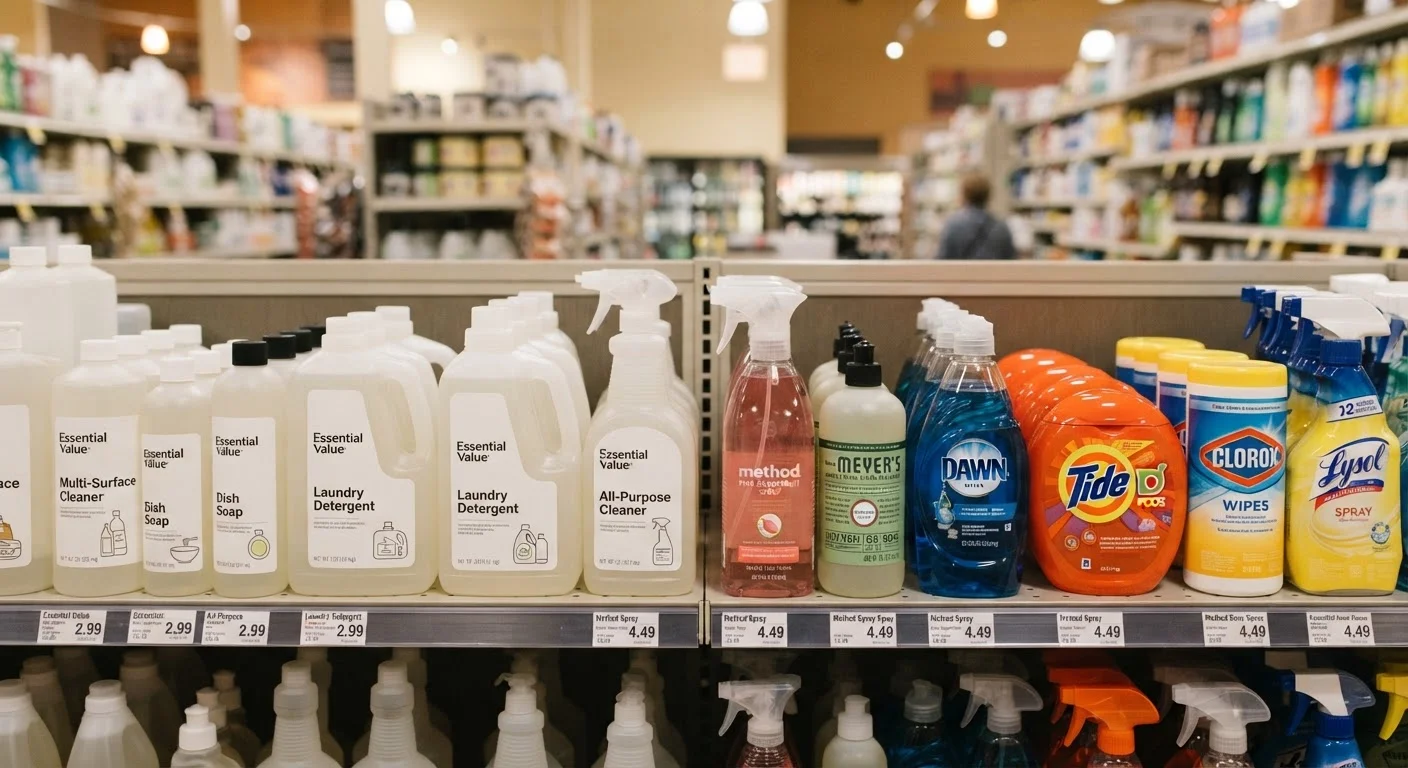
Photo: UnlockTopics.com | Unlocking Trending Content editorial
Key Takeaways
- Generic and name-brand products often share similar active ingredients, but formulation ratios and additives can differ.
- Marketing costs, not manufacturing differences, account for much of the price gap between the two.
- Some product categories reward store-brand buying; others have meaningful performance gaps worth paying for.
- Reading ingredient lists and labels is the most reliable way to compare products across price tiers.
- Certifications and performance specs can signal genuine quality differences independent of brand recognition.
Where the Price Gap Actually Comes From
When you place a store-brand all-purpose cleaner next to a name-brand version, the price difference can be striking - sometimes 30 to 50 percent. But the gap rarely reflects a proportional difference in what's actually inside the bottle.
Name-brand manufacturers invest heavily in advertising, sponsored research, retail placement fees (called slotting fees), and packaging design. Those costs are built into the retail price. Generic products, by contrast, typically skip most of that overhead. They're often produced by contract manufacturers - sometimes the same facilities that produce name-brand goods - and sold with simpler packaging and no ad spend.
This doesn't mean all generics are identical to their branded counterparts. Formulation ratios, fragrance profiles, and secondary ingredients can differ. But the core functional ingredient - the surfactant in dish soap, the bleach concentration in a disinfectant - is frequently the same or very close. Comparing unit prices is one practical way to cut through the noise and see what you're actually paying per ounce or use.
| Criterion | Generic (Store-Brand) | Name-Brand |
|---|---|---|
| Typical price point | Lower - 20-50% less on average | Higher - includes marketing overhead |
| Active ingredient parity | Often similar or identical | Consistent, documented formulation |
| Third-party certifications | Variable - check label carefully | More commonly tested and certified |
| Ingredient disclosure | Sometimes limited | Generally more detailed |
| Formulation consistency over time | Can change without notice | More stable across production runs |
| Packaging information | Minimal but functional | Detailed, often with usage guidance |
| Best use context | Routine, high-volume consumables | Certified or specialized performance tasks |
Product Categories Where It Actually Matters
The generic-versus-brand decision isn't uniform across product types. Some categories have genuine performance differentiation; others are essentially commodities dressed up in different boxes.
Categories where generics typically perform comparably
- Basic cleaning supplies (all-purpose sprays, dish soap, glass cleaner): Active ingredient concentrations are often similar, and the cleaning task doesn't require precision chemistry.
- Paper goods (trash bags, paper towels): Ply count and sheet size are measurable - check those specs rather than the brand name.
- Storage items (zip-close bags, plastic wrap): Thickness and seal quality matter; these can be verified by reading product specs, not brand alone.
Categories where name-brand may offer a real advantage
- Filtration products: HEPA filters and water filters often have certified performance ratings tied to a specific tested product. Generic substitutes may not carry equivalent third-party testing.
- Adhesives and sealants: Cure time, bond strength, and chemical compatibility can vary meaningfully between formulations.
- Specialty disinfectants: EPA-registered disinfectants list specific claims (kill rates for particular pathogens) tied to that exact formulation. A generic that looks similar may have a different EPA registration - or none at all.
Understanding what product certifications actually verify can help you evaluate whether a label on either type of product is meaningful or just decorative.
~25-40%
Typical price difference, generic vs. name-brand
Consumer research consistently finds store-brand household products priced significantly below name-brand equivalents across cleaning, paper, and storage categories.
~15%
Share of US grocery sales from store brands
Store-brand products have grown steadily in market share, reflecting broader consumer recognition that private-label quality has improved across categories.
How to Evaluate Without the Marketing Noise
Stripping brand perception out of the decision requires looking at a few concrete things rather than packaging impressions.
- Read the active ingredient list. For cleaning products, the active ingredient and its concentration determine functional performance. If two products list the same active ingredient at the same percentage, they are chemically doing the same job.
- Check for third-party certifications. A certification from a credible third-party organization - not a self-declared badge - indicates independent verification. The certifying body and what it actually tested for matters more than its visual prominence on the label.
- Factor in consistent availability. Store-brand formulations can change without notice. If you find a generic that works well, note the specs so you can compare future versions or find an equivalent if it's discontinued.
- Test in low-stakes categories first. Start by swapping generics into routine consumables - dish soap, trash bags, multi-surface cleaner - and evaluate performance over a few weeks before switching categories that matter more to your household.
Price doesn't reliably signal quality across all home product categories. Building a category-by-category view of where you'll spend and where you'll save is more practical than any blanket rule. See how to formalize that thinking in our guide to building a sustainable household buying strategy.
A Note on 'Made in the Same Factory'
The content on this site is for informational purposes only and is not a substitute for professional advice. Always consult a qualified professional for guidance specific to your situation.