
Key Terms Every Home Organizer Uses (And What They Actually Mean)

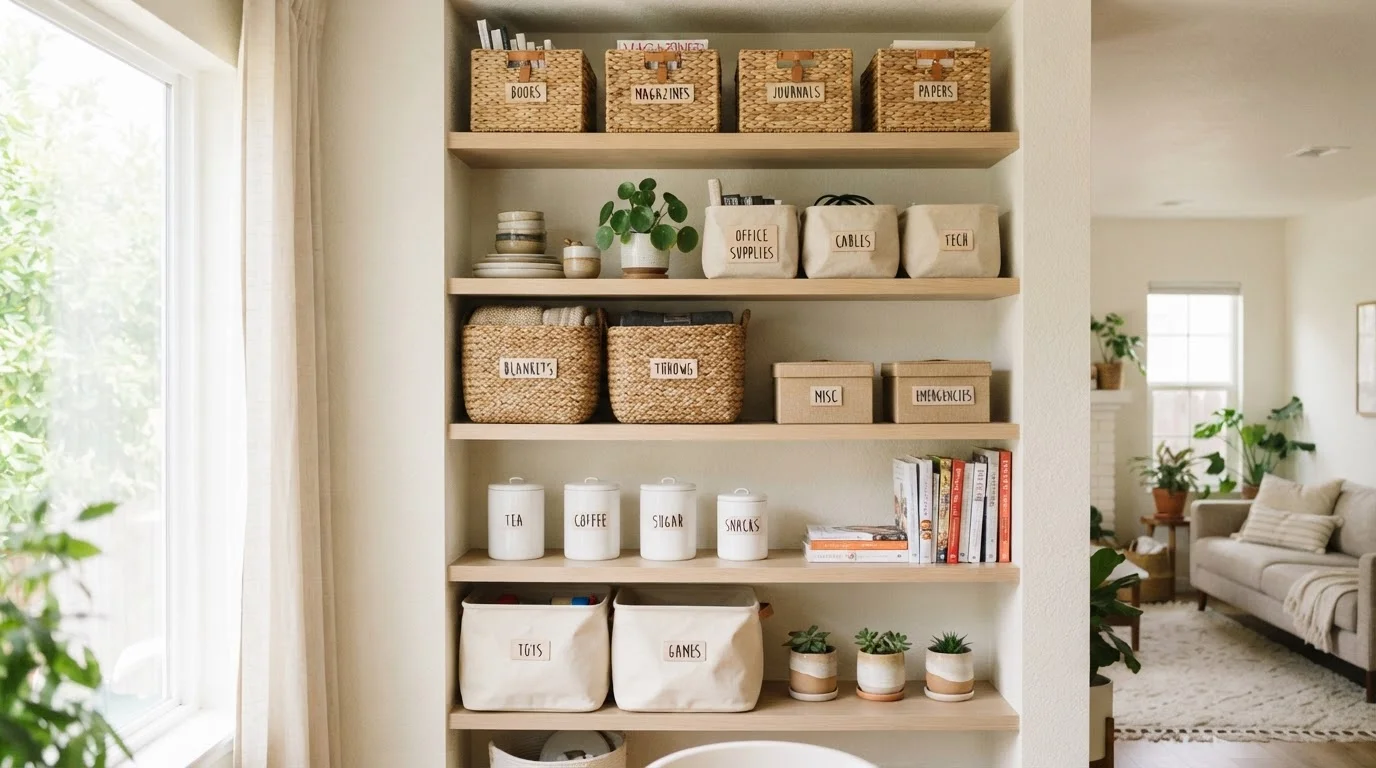
Photo: UnlockTopics.com | Unlocking Trending Content editorial
Why the Language of Organizing Matters
Pick up any home organization guide and you'll encounter a shorthand vocabulary - zones, flow, friction, negative space - that writers use without always stopping to explain. For readers new to intentional organizing, this jargon can make practical advice feel more abstract than it needs to be.
This reference breaks down the terms you'll see most often, in plain language. Understanding what these concepts actually mean - not just as buzzwords but as practical tools - makes it far easier to apply them to your own space. The glossary below covers twelve of the most commonly used terms.
If you want to go deeper on how these concepts combine into a repeatable process, see our end-to-end organizing framework for a thorough walkthrough.
Putting the Terms Into Practice
Knowing a definition is only useful when you can connect it to a real decision. Here's how several of these concepts interact in practice:
- Declutter before you organize. No storage solution works well when there are simply too many items for the space. Sorting with the sunk cost trap in mind helps you let go of things that are only kept out of guilt, not genuine use.
- Design zones around flow. Rather than deciding where something should go based on aesthetics, observe where it naturally ends up. That's flow working against you - and if you design a zone there instead, it works for you.
- Reduce friction to maintain the system. A perfectly organized closet that requires four steps to access will be ignored within a week. Wherever you can remove a lid, add a hook, or shorten a path, do it.
- Leave negative space on purpose. Shelves filled to every edge are harder to maintain than those with breathing room. Intentional gaps also make it immediately visible when something is out of place.
Terminology Varies Across Sources
For workspace-specific applications of these ideas - zones, friction reduction, and flow - our article on keeping a home office functional under daily use translates these concepts directly to a desk environment.
| Core organizing principle | Function before aesthetics |
| Most common clutter zone | Kitchen counter near the entrance |
| First step in any organizing project | Declutter before you organize |
| Purpose of a zone | Reduce daily decision fatigue |
| What 'friction' controls | How consistently items are returned to their place |
The content on this site is for informational purposes only and is not a substitute for professional advice. Always consult a qualified professional for guidance specific to your situation.