
The Glycemic Index: A Useful Tool or an Oversimplification?

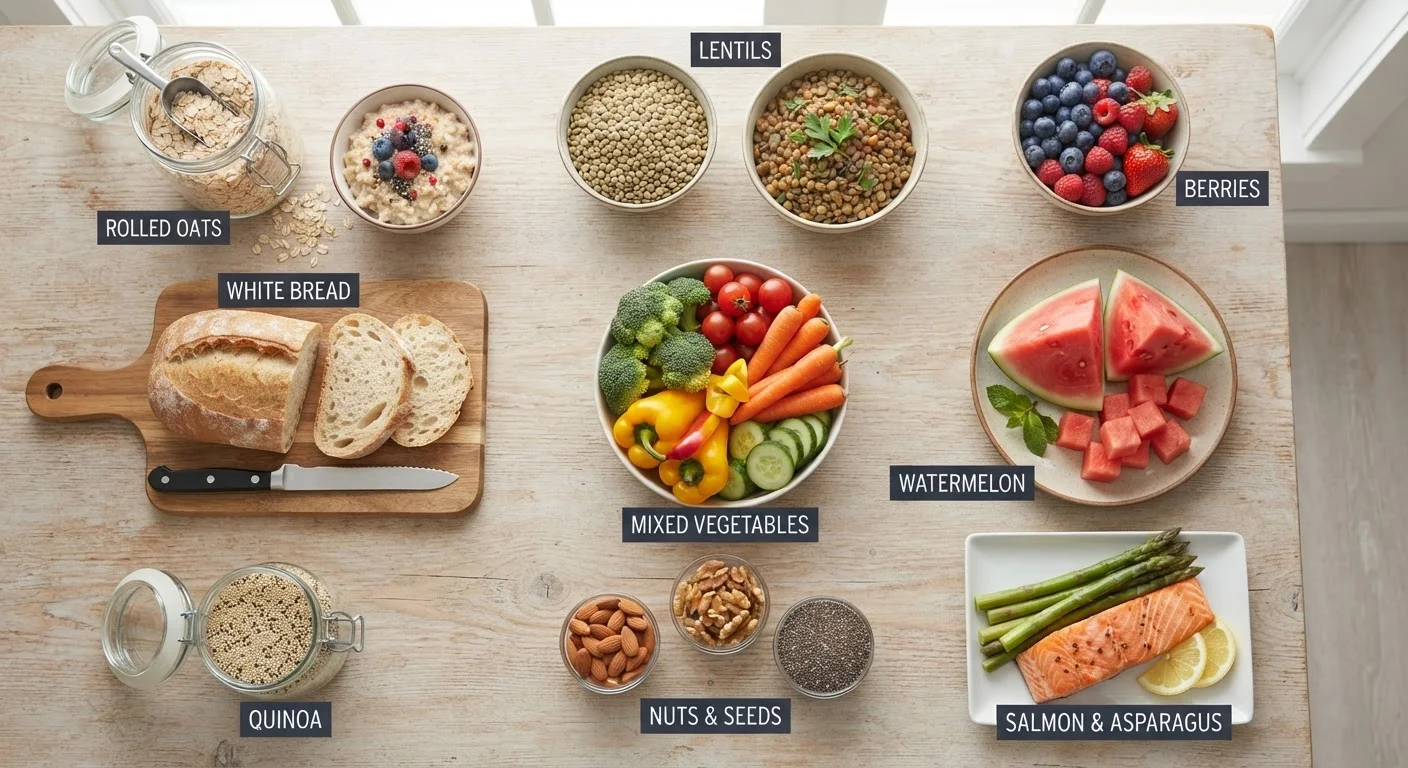
Photo: UnlockTopics.com | Unlocking Trending Content editorial
Key Takeaways
- The glycemic index ranks carbohydrate-containing foods by how quickly they raise blood glucose.
- GI can be a helpful guide for blood sugar management, but it does not account for portion size or food combinations.
- A food's glycemic load - GI multiplied by serving size - is often a more practical measure.
- Cooking method, ripeness, and individual biology all influence a food's real-world glycemic effect.
- GI is one useful tool among many, not a standalone dietary framework.
Grounded in clinical research since the 1980s
The GI framework has been studied extensively across populations and is cited in guidelines from major diabetes and nutrition organizations worldwide, giving it more scientific credibility than many popular diet concepts.
Helps distinguish carbohydrate quality at a glance
Rather than treating all carbohydrates as equivalent, GI provides a relative measure of how different foods affect blood glucose, encouraging awareness of carbohydrate quality beyond simple sugar-versus-starch distinctions.
Useful for blood sugar and diabetes management
Low-GI diets have shown benefits for glycemic control in people with type 2 diabetes in multiple clinical studies, making GI a recognized - if partial - tool in metabolic health management.
Can improve satiety and reduce energy crashes
Lower-GI foods tend to digest more slowly, which may support steadier energy levels and more sustained feelings of fullness compared to rapidly digested, high-GI options.
Simple enough for everyday decision-making
Unlike detailed macro tracking, GI offers a relatively accessible shorthand that many people can apply without specialized tools or apps, particularly when choosing between carbohydrate-rich staple foods.
Ignores portion size entirely
Because GI is calculated per 50 grams of digestible carbohydrate rather than a typical serving, it can misrepresent a food's practical impact - a limitation that glycemic load partially corrects.
Does not reflect mixed meals
GI values are measured for single foods in isolation; fat, protein, and fiber from other meal components significantly alter glucose absorption, making stand-alone GI figures poor predictors of real meal responses.
Significant individual biological variation
Research shows that blood glucose responses to the same food vary substantially between individuals based on gut microbiome, genetics, and lifestyle factors - undermining the usefulness of a universal GI ranking.
Cooking and ripeness change values unpredictably
The same food prepared differently - pasta cooked al dente versus soft, or a green banana versus a ripe one - can have meaningfully different GI values, reducing the reliability of published tables in practice.
Can mislead by labeling nutritious foods as 'bad'
Some nutrient-dense foods like carrots and watermelon carry medium-to-high GI ratings, which can discourage consumption of foods that are otherwise excellent sources of vitamins, minerals, and fiber.
What the Glycemic Index Actually Measures
The glycemic index (GI) is a numerical scale - typically from 0 to 100 - that ranks carbohydrate-containing foods based on how quickly they raise blood glucose levels compared to a reference food, usually pure glucose or white bread. Foods scoring 55 or below are considered low-GI; 56-69 is medium; 70 and above is high-GI.
The concept was developed in the early 1980s by Dr. David Jenkins and colleagues at the University of Toronto as a research tool for understanding carbohydrate quality - not as a consumer diet system. GI values are measured under controlled laboratory conditions: participants consume a fixed amount of a food containing 50 grams of digestible carbohydrates, and their blood glucose response over two hours is tracked.
Understanding this controlled-testing context is essential, because real-world eating rarely matches it. Still, for readers who want to decode carbohydrate quality at a glance, the GI provides a credible starting point. For guidance on reading carbohydrate data directly from packaging, our nutrition label guide covers how to interpret those figures clearly.
Grounded in clinical research since the 1980s
The GI framework has been studied extensively across populations and is cited in guidelines from major diabetes and nutrition organizations worldwide, giving it more scientific credibility than many popular diet concepts.
Helps distinguish carbohydrate quality at a glance
Rather than treating all carbohydrates as equivalent, GI provides a relative measure of how different foods affect blood glucose, encouraging awareness of carbohydrate quality beyond simple sugar-versus-starch distinctions.
Useful for blood sugar and diabetes management
Low-GI diets have shown benefits for glycemic control in people with type 2 diabetes in multiple clinical studies, making GI a recognized - if partial - tool in metabolic health management.
Can improve satiety and reduce energy crashes
Lower-GI foods tend to digest more slowly, which may support steadier energy levels and more sustained feelings of fullness compared to rapidly digested, high-GI options.
Simple enough for everyday decision-making
Unlike detailed macro tracking, GI offers a relatively accessible shorthand that many people can apply without specialized tools or apps, particularly when choosing between carbohydrate-rich staple foods.
Where the Glycemic Index Falls Short
Despite its research foundation, GI has meaningful real-world limitations that nutrition scientists have documented over decades.
Portion size is ignored. GI is measured per 50 grams of digestible carbohydrate - not per typical serving. Watermelon has a high GI (around 72), but a standard serving contains so few carbohydrates that its actual blood sugar impact is modest. This gap is why researchers developed glycemic load (GL), which multiplies GI by the carbohydrate content of a realistic portion and divides by 100. GL gives a much closer approximation of real-world impact.
Food combinations change outcomes. Eating carbohydrates alongside fat, protein, or fiber slows digestion and blunts blood glucose spikes significantly. A potato eaten plain behaves very differently from a potato eaten with olive oil, chicken, and vegetables - yet GI tables treat them the same.
Individual variation is substantial. Research published in Cell by Zeevi and colleagues demonstrated that two people eating identical foods can have dramatically different blood glucose responses, shaped by gut microbiome composition, activity levels, sleep, and stress. A universal GI number cannot capture this variability.
Preparation method matters. Cooking, cooling, processing, and ripeness all shift a food's GI. Al dente pasta has a lower GI than well-cooked pasta. A ripe banana has a higher GI than an underripe one. These nuances rarely appear on GI reference tables.
Ignores portion size entirely
Because GI is calculated per 50 grams of digestible carbohydrate rather than a typical serving, it can misrepresent a food's practical impact - a limitation that glycemic load partially corrects.
Does not reflect mixed meals
GI values are measured for single foods in isolation; fat, protein, and fiber from other meal components significantly alter glucose absorption, making stand-alone GI figures poor predictors of real meal responses.
Significant individual biological variation
Research shows that blood glucose responses to the same food vary substantially between individuals based on gut microbiome, genetics, and lifestyle factors - undermining the usefulness of a universal GI ranking.
Cooking and ripeness change values unpredictably
The same food prepared differently - pasta cooked al dente versus soft, or a green banana versus a ripe one - can have meaningfully different GI values, reducing the reliability of published tables in practice.
Can mislead by labeling nutritious foods as 'bad'
Some nutrient-dense foods like carrots and watermelon carry medium-to-high GI ratings, which can discourage consumption of foods that are otherwise excellent sources of vitamins, minerals, and fiber.
How to Apply GI Practically Without Overstating It
Used with appropriate expectations, the glycemic index can help build a more carbohydrate-aware dietary pattern without requiring obsessive tracking.
Glycemic Index vs. Glycemic Load
A practical approach is to use GI as a directional signal rather than a precise prescription. Prioritizing lower-GI carbohydrates - legumes, intact whole grains, most non-starchy vegetables - tends to align with broader dietary patterns associated with sustained energy, better satiety, and favorable metabolic markers. This is consistent with recommendations from bodies including the American Diabetes Association, which supports considering GI and GL as part of individualized carbohydrate management.
Pairing any carbohydrate source with adequate protein, healthy fat, and fiber is a more reliably effective strategy for moderating blood glucose than selecting foods by GI number alone. For a meal-level framework that integrates these principles without calorie counting, see our guide to building a balanced plate.
~15 points
Average GI reduction from al dente vs. soft-cooked pasta
Studies have shown that cooking method alone can shift a food's GI by a clinically meaningful margin, highlighting how preparation affects real-world glycemic response.
~10x
Variation in blood glucose response between individuals
Research by Zeevi et al. published in Cell (2015) found up to tenfold differences in glycemic response to identical foods across participants, driven by microbiome and lifestyle factors.
Anyone with diabetes, prediabetes, or a metabolic condition should work with a registered dietitian or physician to determine whether GI-focused eating is appropriate for their specific situation. General nutrition information - including this article - is not a substitute for personalized medical or dietary advice.
This article is for general informational and educational purposes only and does not constitute medical or dietary advice. Consult a qualified healthcare professional before making changes to your diet, especially if you have a health condition.
The content on this site is for informational purposes only and is not a substitute for professional advice. Always consult a qualified professional for guidance specific to your situation.