
Reading a Nutrition Label Without Getting Confused

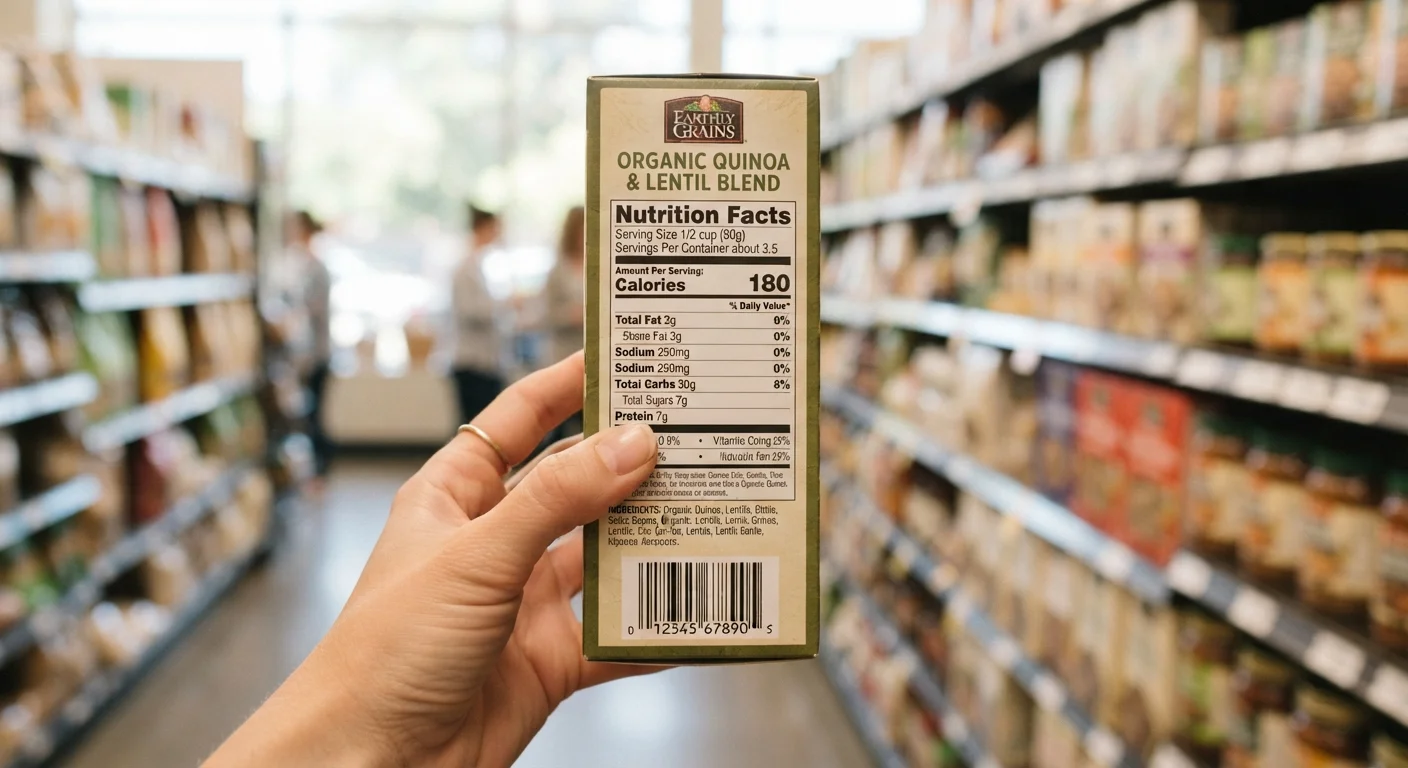
Photo: UnlockTopics.com | Unlocking Trending Content editorial
Key Takeaways
- Serving size is the foundation of every number on the label - always check it first.
- Percent Daily Values (%DV) are based on a 2,000-calorie reference diet, not your personal needs.
- Ingredients are listed by weight, so the first few entries dominate the product's composition.
- Aim for higher %DV for fiber, vitamins, and minerals, and lower %DV for saturated fat and sodium.
- Front-of-package claims are marketing; the Nutrition Facts panel and ingredient list are the real data.
Why the Nutrition Facts Panel Exists
The Nutrition Facts label is a federally mandated disclosure, regulated by the U.S. Food and Drug Administration (FDA) and required on most packaged foods sold in the United States. It was first introduced in 1994 following the Nutrition Labeling and Education Act, and significantly updated in 2020 to reflect current nutritional science - including the addition of a dedicated line for added sugars and revised serving sizes that better reflect how people actually eat.
The label's purpose is transparency: to give consumers a standardized, comparable snapshot of a food's nutritional content. Front-of-package claims - 'low fat,' 'high fiber,' 'heart healthy' - are marketing language and subject to less rigorous oversight. The Nutrition Facts panel and ingredient list are where the verifiable data lives.
When you pair label literacy with broader food knowledge - such as understanding how to build a balanced plate - you're better equipped to make choices that align with your actual nutritional goals rather than packaging persuasion.
Front-of-Package Claims Can Mislead
How to Read the Label: Step by Step
Reading a nutrition label efficiently is a learnable skill. The steps below walk you through the panel in the order it's designed to be read - from the top (serving information) to the bottom (micronutrients and allergens). Once this sequence becomes habit, a thorough label review takes under a minute.
What you will need
Nutrition Facts Panel
The standardized FDA-regulated section of any packaged food that discloses calories, macronutrients, and key micronutrients per serving.
Ingredient List
Lists every ingredient in the product by descending weight, helping you identify what the food is primarily made of.
Smartphone or Magnifying Glass
Useful for reading fine-print ingredient lists, especially on smaller packaging.
Start with serving size and servings per container
Every number on the label - calories, fat, sodium, everything - refers to one serving, not the entire package. The serving size is listed at the very top of the Nutrition Facts panel, followed by the number of servings per container.
A bag of chips labeled '150 calories' with 3 servings per container contains 450 calories total. This single detail changes how you interpret every other figure on the label, so check it before reading anything else.
Read the calorie count in context
Calories measure the energy a food provides. After confirming the serving size, note the calorie count per serving. Calorie needs vary widely by age, sex, activity level, and health status - the 2,000-calorie reference used on labels is a general benchmark, not a universal target.
Calories alone don't tell you about nutritional quality. A 200-calorie serving of almonds and a 200-calorie serving of a sugary snack cake deliver very different nutrients. Use calories as one data point, not the only one.
Scan the macronutrient section
Below the calorie line you'll find the three macronutrients: total fat, total carbohydrate, and protein. Each is broken into subcategories worth examining:
- Fat: Look at saturated fat and trans fat specifically. Saturated fat is associated with cardiovascular risk when consumed in excess; artificial trans fat is largely eliminated from the US food supply but still worth checking. Unsaturated fats are not separately labeled but are beneficial in the context of an overall healthy diet.
- Carbohydrate: Total carbohydrate includes dietary fiber and total sugars. Dietary fiber supports digestive health and satiety. The label also lists added sugars separately - this reflects sugars added during processing, distinct from those naturally present in fruit or dairy.
- Protein: No %DV is required for protein on most labels, so you'll see grams only. Protein supports muscle maintenance, satiety, and many metabolic functions.
For deeper context on how each macronutrient functions in the body, see our macronutrients guide.
Interpret Percent Daily Values (%DV)
Percent Daily Value (%DV) tells you how much of a nutrient one serving contributes toward a general daily reference amount, based on a 2,000-calorie diet. It appears as a percentage in the right-hand column of the label.
Use %DV directionally: you generally want more of fiber, vitamin D, calcium, iron, and potassium, and less of saturated fat, sodium, and added sugars. The FDA provides a simple benchmark - 5% DV or less is low; 20% DV or more is high - which makes it easy to compare products without specialized knowledge.
Read the ingredient list from top to bottom
Ingredients are listed in descending order by weight. Whatever appears first makes up the largest proportion of the product. If refined sugar or a highly processed oil is among the first three ingredients, that food is predominantly composed of those substances.
A long ingredient list isn't automatically a problem - some whole-food products (like a mixed-nut blend with seasoning) have lengthy lists. Conversely, a short list doesn't guarantee nutritional quality. Focus on what the top ingredients actually are, not how many there are.
If you want to understand how processing level connects to ingredient lists, our guide on ultra-processed foods provides useful context.
Check micronutrients and allergen disclosures
The bottom section of the Nutrition Facts panel lists key micronutrients: vitamin D, calcium, iron, and potassium are required by the FDA. These are nutrients that Americans commonly under-consume, which is why they were prioritized in the updated label format introduced in 2020.
Separately, look for the allergen statement - typically printed below the ingredient list. US law (FALCPA and the more recent FASTER Act) requires disclosure of the nine major allergens: milk, eggs, fish, shellfish, tree nuts, peanuts, wheat, soybeans, and sesame. This statement is especially important for anyone managing a food allergy or intolerance.
For a full reference on what vitamins and minerals do in the body, see our vitamins and minerals guide.
Use %DV as a Quick Compass
Labels Inform - They Don't Replace Professional Advice
This article is for general informational and educational purposes only and does not constitute medical or dietary advice. Individual nutritional needs vary. Consult a registered dietitian or qualified healthcare professional for personalized guidance.
The content on this site is for informational purposes only and is not a substitute for professional advice. Always consult a qualified professional for guidance specific to your situation.