
Sitting Less During the Day: Small Adjustments That Add Up

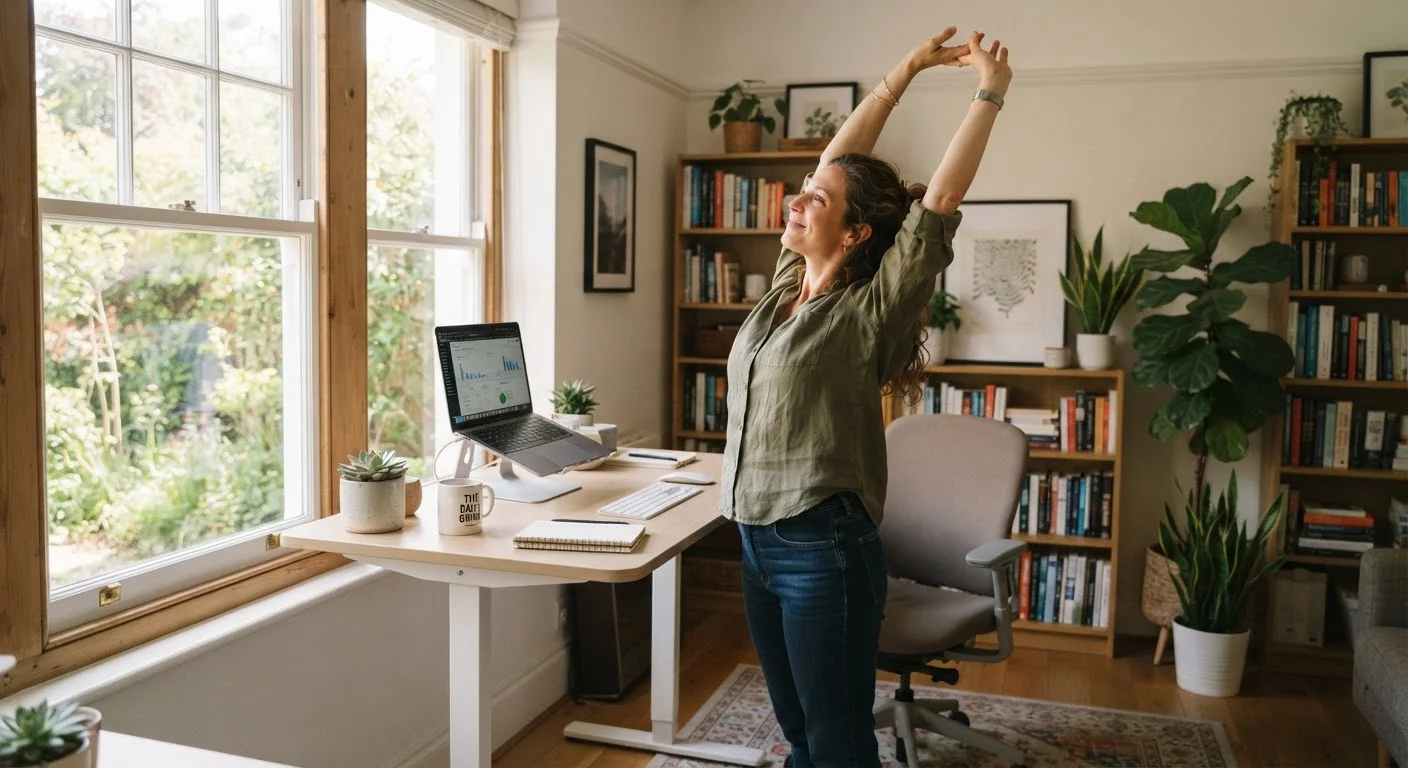
Photo: UnlockTopics.com | Unlocking Trending Content editorial
Key Takeaways
- Prolonged uninterrupted sitting is associated with several health concerns independent of overall exercise habits.
- Short, frequent movement breaks are more practical and sustainable than long exercise sessions for desk workers.
- Simple environmental changes - like a standing mat or rearranged workspace - can prompt more natural movement.
- Walking meetings, standing during calls, and micro-stretches require no equipment and fit into most schedules.
- Consistency in small movement habits matters more than intensity for reducing sedentary time.
Why Breaking Up Sitting Time Matters
For many people, desk work means sitting for six, eight, or even ten hours a day. Research published in journals such as the British Journal of Sports Medicine suggests that prolonged, uninterrupted sedentary time is associated with elevated risks for cardiovascular issues, metabolic changes, and musculoskeletal discomfort - even among people who exercise regularly outside of work. In other words, a morning run does not fully offset eight straight hours in a chair.
The good news: the intervention doesn't need to be dramatic. Evidence points to frequent, shorter bouts of movement distributed across the day as a practical and achievable target. If you're also thinking about how your overall workspace is set up, see our guide on organizing a functional home office - a well-arranged space makes movement easier to build in naturally.
The adjustments below are designed to be low-friction and genuinely sustainable, not punishing. Think of them as friction-reducing, not discipline-requiring.
Set a movement reminder every 45-60 minutes
The simplest intervention is also one of the most evidence-supported: a recurring reminder to stand up and move. Whether you use a phone alarm, a smartwatch prompt, or a browser extension, a regular cue disrupts the inertia of sitting without requiring you to track time mentally.
When the reminder fires, you don't need a structured exercise break - standing up, walking to a window, or doing a few shoulder rolls is enough to interrupt the sedentary pattern. The goal is frequency, not duration.
Frequency of movement breaks matters more than how long each break lasts.
Take calls on your feet
Phone calls and virtual audio meetings are natural opportunities to stand - or even pace. Because you're not watching a screen, walking while talking is usually feasible without any loss of productivity. Many people find that pacing while thinking actually sharpens focus.
If you work from home, designate a loop around your space as your "call route." Over a full workday, standing during calls alone can add meaningful movement without disrupting workflow. Pair this with a well-positioned workspace: see desk accessories that support better posture for ideas on arranging your setup to encourage upright positioning.
Standing or pacing during calls is one of the easiest movement habits to sustain.
Reposition commonly used items to require standing
A practical nudge: move items you reach for frequently - a water bottle, your notebook, a printer - slightly out of arm's reach so that accessing them requires you to stand. This is a classic behavioral design technique sometimes called "choice architecture," and it works because it removes the decision from the equation entirely.
Similarly, keeping your water at a distance encourages both more movement and better hydration, which is a useful secondary benefit for cognitive function during long work sessions.
Deliberately repositioning everyday items turns routine tasks into movement opportunities.
Incorporate standing or walking into meetings
Walking meetings - conducted on foot rather than around a conference table or on-screen - are well-established in workplace wellness literature and have been reported to increase creativity and reduce decision fatigue in some contexts. For one-on-one check-ins, they're easy to propose.
Even in formal settings, standing for the final ten minutes of a meeting, or choosing a standing location for an informal huddle, reduces accumulated sit time noticeably over a week. Many teams find walking meetings actually run shorter, since ambient motion discourages tangents.
Walking meetings reduce sitting time while often making conversations more focused.
Add a brief movement sequence after each major task
Rather than scheduling breaks by the clock, some people find it easier to attach movement to task completion - a technique borrowed from habit stacking. Finishing a document, sending a report, or closing a project phase becomes a reliable cue to stand up and move for two to three minutes before starting the next task.
A simple sequence might be: stand, roll shoulders, stretch the hip flexors briefly, walk to another room and back. It takes under three minutes and resets posture and attention simultaneously. Over a full workday, these micro-sessions add up significantly.
Attaching movement to task completion makes breaks predictable without needing a timer.
Use a standing mat and alternate positions intentionally
If your workspace allows for a standing option - even a makeshift elevated surface - the key is alternating, not standing all day. Extended standing can cause its own discomfort, particularly in the lower back and feet. The evidence favors a sit-stand cycle rather than a wholesale switch to standing.
A cushioned anti-fatigue mat makes standing more comfortable and extends how long you can do it without strain. Alternating roughly every 30-45 minutes is a reasonable starting approach, though individual tolerance varies. For more ideas on workspace comfort, small home upgrades that change how your space feels covers practical environmental adjustments worth considering.
Alternating between sitting and standing on a cycle is better than replacing one with the other.
Build an end-of-day walk into your routine
A short walk at the end of the workday serves double duty: it adds movement and creates a psychological boundary between work and personal time - a particularly useful ritual for remote workers whose commute has disappeared. Research consistently supports walking as an accessible, low-impact form of movement that contributes meaningfully to daily activity targets.
It doesn't need to be long. Even a 10-15 minute loop around the block, done consistently, creates a movement anchor that reinforces the broader habit of sitting less. For a deeper look at what walking can actually deliver, our article on walking as exercise breaks down the science clearly.
A consistent end-of-day walk creates both movement and a healthy boundary after work.
Building a Movement-Friendly Routine
None of these strategies require special fitness equipment or a restructured schedule. The common thread is environment design: making movement the path of least resistance rather than an act of willpower. Over time, small habits compound. Consistency over intensity is the underlying principle that exercise science returns to again and again, and it applies just as much to daily movement as it does to structured workouts.
If you find walking an appealing way to accumulate movement, the research on walking as exercise is more encouraging than most people expect.
Start With Just One Change
This article is for general informational purposes only and is not a substitute for professional medical advice. If you have a health condition affecting your ability to move or exercise, consult a qualified healthcare professional before making changes to your activity levels.
The content on this site is for informational purposes only and is not a substitute for professional advice. Always consult a qualified professional for guidance specific to your situation.